


Why I Run A Node
My node died a year or so ago (the computer it was running on died), and I never brought it back online…yet. I hadn’t really had much urgency until I started noodling on the Bitcoin Core post v.30 / Knots / BIP-110 issue.
I’ve done a good deal of research on it over the past few months. I’ve changed my mind a couple of times along the way. But I know as a true Bitcoiner: 1) I need to be running a node (a real one with ports open to support the network) and 2) I need to make my node be my vote on what Bitcoin is. That is my duty to Bitcoin.
What Caused The Issue
In October 2025, Bitcoin Core v30 removed the long-standing 83-byte relay limit on OP_RETURN outputs and raised the default relay limit to about 100,000 bytes (100 KB).
This was a relay policy change and not a consensus rule change.
But the change was fairly contentious. They chose to make it anyway. It has even been suggested (and probably proven) that the change was pushed through via a “coopted” Core dev team. If the Core devs are malicious actors (or funded by them) who have a financial interest in expanding Bitcoin beyond its monetary use case in order to damage Bitcoin, that is obviously not good.
Regardless of the reason for the change, it was made. If you believe it was made by good actors, it might be okay (as long as you are okay with non-monetary use cases existing on Bitcoin). But it definitely changed Bitcoin. If you believe it was made by people with ill intent, it probably is not okay.
This is the hill the BIP-110 crowd intends to die on. They want the extra data limit enforced and the non-monetary use cases removed. They say it is existential for Bitcoin. If it is existential, I agree with them. If it is not, I do not agree with them.
What Is Bitcoin?
I believe Bitcoin is a monetary network and ONLY a monetary network. Other use cases have no place mucking up the code (or my node). We should not be making changes that potentially disrupt Bitcoin’s main use case (or increase attack vectors to it). More functionality (or changing existing functionality) can do that. I’ve worked in operational roles my entire life and live by the motto “if it ain’t broke, don’t fix it” (especially if it is a business-critical system or process). That is exactly what Bitcoin is. It is a monetary network that has operated for almost 2 decades without fail and stores $1.2-ish trillion of value. It is not something we want to be messing with unless we need to. I’m an ossification proponent. Let Bitcoin do its thing. Fix major issues if/as they arrive but otherwise leave it alone. I personally have no use for non-monetary use cases and believe they are silly (which is why I never bought any other cryptocurrency).
That said, just because that is what I want doesn’t make it so. Bitcoin doesn’t care. There could be other use cases. Who am I to say there are not? But…I will say there are not! F ‘em!
Is Extra Data On Our Nodes Problematic?
Due to the change, my node (and everyone else’s who hasn’t gone over to Knots, or updated their nodes’ data handling parameters) is now storing extra data that is unnecessary for the monetary use case. Since that time, the size of the blockchain has grown a bit quicker than in times past. In October 2025 it was 675GB and is now 752GB (grew 77GB or 11.4% in about 9 months). Over the prior 16 years, it grew to 675GB (42-ish GB a year). Runes and Inscriptions (non-monetary uses) initially added data fairly quickly and even drove fees up for a while. Since then, this data has slowed considerably, and the fees have also settled. Overall, the extra data is not a huge issue.
The BIP-110 proponents will say we don’t need to store the extra data. I agree with them. They’ll say it is an existential threat. I don’t agree with that. Storage space/expense will likely grow faster than the data being stored.
Does it make running a node more expensive, and are nodes storing potentially unnecessary data indefinitely? Yes, absolutely. Storing data, permanently, that is potentially not necessary for a node operator is silly.
Will the fee market “price out” the nonmonetary uses (and associated use/data storage)? Yes, likely. If the monetary use case is the major use case, the fee market will be driven by that use case.
The final boss of this battle is CSAM (Child Sexual Abuse Material). When all the above arguments are put to bed, several BIP-110 proponents end the argument with “you are a pedophile who wants CSAM on the blockchain” [paraphrased]. What?! And no, BTW! LOL. For them, this is the ultimate attack vector and “ends Bitcoin”. I’m not sure I agree with that. It wouldn’t be the best thing to happen, but I’m pretty sure it doesn’t “end Bitcoin”. If someone uses a protocol to store data that is illegal, that doesn’t make the protocol the issue. Plenty of illegal things happen on ‘protocols’. We still use them. Has CSAM ever been sent over the internet? Over email? Both protocols everyone uses every day. Has CSAM ever been put in a car and driven down the interstate? Roads are kinda protocols. Have other illegal activities ever occurred on the internet, email, mail, interstates? Of course! The protocols survived. Making an “emergency” and “existential” claim without 1) proof of such and 2) without broad consensus doesn’t make it an emergency.
Additionally, I’ve read about the risks of running a node that stores illegal information and have no reason to believe there is any legal risk to a node runner if this were to happen.
Soft Forks
Knots and BIP-110 supporters are proposing a soft fork that will go into effect in August of 2026. Soft forks narrow the rules, and hard forks change the rules. So, a soft fork that ‘restores the data relay limit’ back to what it was prior to v30 is the intention.
I believe a soft fork (or threat of one) is a pretty big deal. People have/will attempt them all the time. This is fine and a feature of Bitcoin. Don’t like the direction, fork it, and fix it yourself. If people agree with you, your fork will win and become the consensus chain that everyone uses.
That said, I believe a soft fork (or hard fork) should be reserved for clear, serious, and broadly understood failures. It has to fix a MAJOR problem that basically EVERYONE believes needs fixing that is seriously impacting Bitcoin.
BIP 110 does not correct an issue like this. Issues that would require a soft fork would be inflation, signature validation, double spending, or a known critical bug.
Protocol changes should prevail only when there is overwhelming alignment (that is not the case here).
Others argue that the solution to the problem BIP-110 intends to solve is not even a good technical solution (i.e. the Knots implementation). I don’t know about that. I’m not a developer who has spent time on this issue. I have to leave that to the developers. But I do know it intends to change Bitcoin (consensus rules). I believe if that is not needed (to change consensus rules), then we shouldn’t do that. The problem they are trying to fix was created by a relay policy change and not a change to the consensus rules. So why do we need a change to the consensus rules to “fix” it? I do not believe we do.
So, if the problem is not an emergency, and the fork doesn’t materially stop spam, and it comes with some trade-offs, don’t do it, since Bitcoin is fine!
BIP-110 supporters claim “the problem” is existential (ultimately CSAM, which they say ends Bitcoin). But I believe it isn’t. Otherwise, there wouldn’t be so much argument going on. Everyone would be ready to get this issue fixed/resolved quickly and without much argument if it was truly an emergency.
For example, if quantum computers (another hotly debated issue) somehow rise up rapidly and start blowing through public keys to gain access to private keys (and subsequently people’s Bitcoin). That would be a no-brainer problem that every Bitcoiner would want resolved ASAP. I can’t imagine anyone arguing too long about that! Update, fork, whatever…fix it!
IMHO, Bitcoin is fine right now. No soft fork needed.
I’m not entirely happy with the situation, but it is not existential. No soft fork needed.
True Threat(s) To Bitcoin
Decentralization and security are critical attributes that must stay alive and well in order for Bitcoin to survive and thrive. The different power structures of Bitcoin each have their part to play (nodes, hodlers, miners, devs). Every element of Bitcoin is currently under attack via centralization at this time. That might be existential.
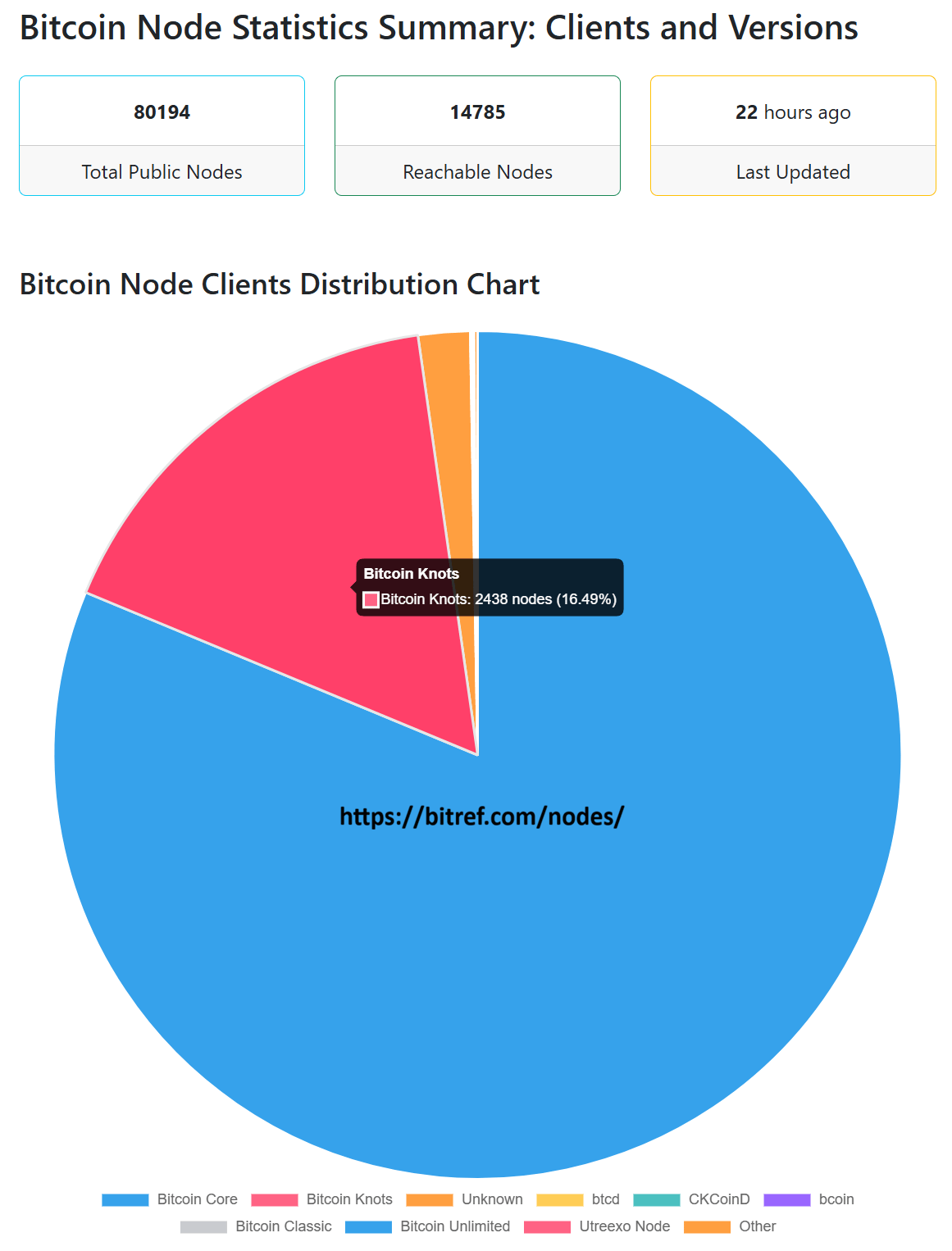
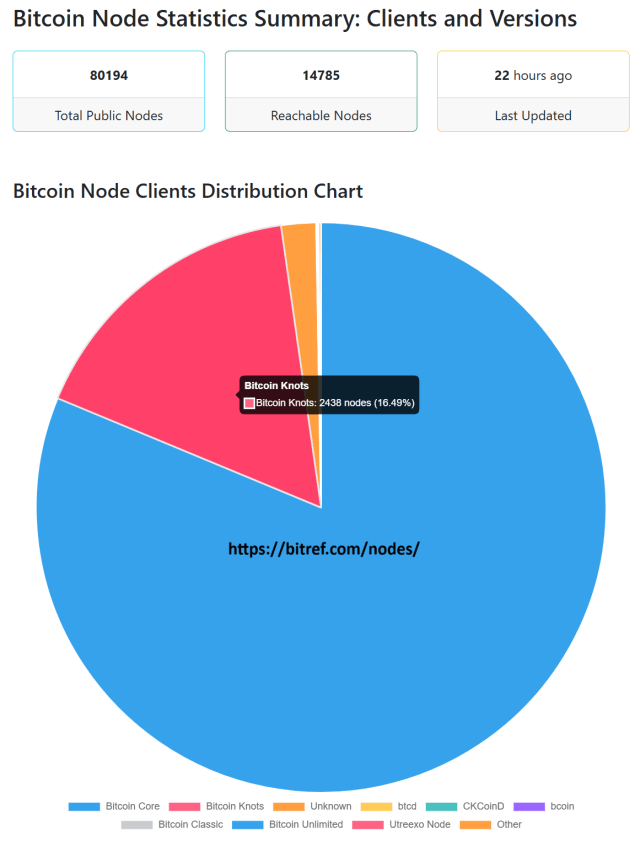
- Nodes – Until Knots started rising up recently, almost every node has run Core’s software. It is not a bad thing that BIP-110 has created a more decentralized node network. The last I saw, it is now 81-ish% Core (various versions) and 17-ish% Knots. This is a dramatic shift in the past year. Fine with me! It definitely sends a strong message that a lot of Bitcoiners are serious about the direction Core dev is headed. The nodes have proven they are in control in the past with Bitcoin. They are the decentralized final boss in setting the rules for Bitcoin. Interestingly, less than 18% of the nodes are running the contentious v30+ software (most Core nodes still run older versions of the software). Message sent? Perhaps the ‘evil Core devs’ will think twice before they mess with the Bitcoin cyber hornet node runners going forward.
- HODLers – Suitcoiners and institutions are becoming major HODLers (increasing centralization). Buyers like Bitcoin Treasury Companies and the Bitcoin ETFs are buying up Bitcoin supply and becoming larger and larger percentages of the outstanding supply. That is either good or bad. The BIP-110 proponents weave this into their argument often. They (BIP-110 proponents) are the true “cyber hornets,” and they will protect Bitcoin at all costs, while the “evil suit coiners” will not (and in fact will try to destroy Bitcoin). On top of it not making any sense (why would someone who owns a metric shit ton of an asset be trying to destroy it), I have no idea why this even comes up in these discussions. The two issues have nothing to do with each other. I, honestly, believe it winds up being jealousy talking. Regardless, it has nothing to do with ‘should we change Bitcoin and/or soft fork to do it’.
- Miners – Mining has been centralizing greatly as a few mining pools control the vast majority of hash rate. That is worrisome for Bitcoin. The BIP-110 proponents also bring this issue into the mix, saying how the miners need to bow down to the nodes (because the nodes set the rules…not the miners). They intend to send a message to the miners that they either signal for it or ‘we will throw your blocks out’ if you don’t and you keep including the extra data. Miner centralization is also unrelated to BIP-110 (other than they earn money in fees to include extra data in their blocks and then saddle the node runners with the burden of carrying the extra data with no compensation). Again, the cyberhornets might be a bit too big for their britches. Run your node(s) and let the miners run their ASICS. The two are unrelated activities, ultimately.
- Devs – HODLonaut wrote a very interesting document that probably proves that Bitcoin Core Dev has been transformed from a diverse, decentralized open source project to a DEI hire groupthink project. Very anti-Bitcoin ethos. People use this to argue that BIP-110 is existential. Run Knots or Bitcoin dies at the hands of the evil Core dev team. Regardless, again, the two are unrelated. If you don’t like the Core dev team, then run Knots (or vice versa), or another node software. There are issues with both, and neither is perfect. It is probably better for Bitcoin to have a couple of major implementations running simultaneously anyway. The more fighting, the better. If everyone is fighting about stuff, they have less time to roll changes that will mess everything up. If more people are looking at each other’s code, everyone will know when things change (like the 83-byte relay limit on OP_RETURN outputs). I know this issue has helped me learn a lot about how Bitcoin works. Hell, I’ve had to write a document about it to make sure I understand everything happening and decide what to do about it. I’ve invested a good deal of time and energy seeking my correct answer (don’t trust…verify). Knowing/understanding more about Bitcoin would be a good thing for the average Bitcoiner.
What Am I Going To Do?
The day I first started thinking about all this, I tweeted:
I don’t think BIP-110 HAS to win in order for Bitcoin to survive and for the monetary use case to win.
Stupid spammers will go away and get out competed for block space by real legitimate uses (money).
BUT I’m gonna run Knots anyway. Because fuck them for messing with my coin!
I believe Bitcoin should be optimized for being the world’s hardest money—not the world’s most expensive data storage system. That said, making a relay policy change (and not a consensus rule change) that removed the long-standing 83-byte relay limit on OP_RETURN outputs is not the end of the world. It isn’t good, but it is not existential. For that reason, we should not be messing around with a soft fork to “fix” it. Since, I believe, soft forks should only be used to fix emergencies.
So, I’m going to run Core…BUT…I’m not going to run v30 (or higher). I’m going to run the last version before that for now. I’ll watch how things play out on this issue (and others). I’ll watch how the Core dev team behaves in the future. I’ll watch how the Knots dev team (or guy) behaves in the future. I might change my mind in the future based on all this.
But for now, I’m going to do my part to help decentralize and secure the Bitcoin network by running a Bitcoin Core 29.2 node. 1 node out of about 15,000 reachable nodes. Doing my part to help decentralize and secure Bitcoin. I’ll give up the patches and bug fixes of the more current versions for a while to make a statement about the v30 changes that “I don’t like it”. A lot of people don’t run new versions of software anyway (they don’t want to be dealing with introduced bugs associated with newer features). I’ll eventually have to decide if I want to run Core v30+ or switch to Knots. But I’ll do that later. I’ve changed my mind on this entire topic a few times over the past few months. I might wind up changing my mind again as new information enters my dull brain. But this is my best effort at trying to understand the issue and do my part to deal with it for myself and for Bitcoin.
Them: But Deano, you are being a puss! Pick one! You are either a BIP-110 Bitcoin Anarchist or a Woke Big Bitcoin Soy Boy.
Me: I’m neither. As my Twitter profile says, “An Enterprising Investor! Trying to allocate my capital to grow it AND keep it!” Despite me not really liking the antics of Bitcoin Core Dev, I think I’ll continue to utilize their software on my node. I’m doing this because I do not believe Knots/BIP-110 soft fork are the correct response. But I’ll not upgrade to v30 for now to thumb my nose at Bitcoin Core Dev. For now! I don’t intend to stay on v29.2 for too long. I’ll keep reading, researching, and monitoring both communities. I will eventually make the decision to continue with Core (and upgrade) or something else. But that doesn’t need to be now (as the issue is not existential). If Bitcoin Core Dev continues to make changes that are not in line with my view of Bitcoin (as a monetary network) AND they continue to do it in a contentious manner (by ignoring large groups of community feedback), I’ll have my answer. At that point, maybe a soft fork will be the right answer. But, it ain’t now! Tick tock, next block.
HODL,
Deano
I’d like to thank people from both sides of this debate who have posted their thoughts about all this on The Twitter. It is helpful to consider other people’s thoughts on this to help me nail down my thinking. I found things posted by these people useful along the way. @1914ad @dotkrueger @saylor @LynAldenContact @nithusezni @hodlonaut @_Adrian


I happened to come across this today, one day before BIP110 officially goes live.
It’s a great article. Your perspective is very much like mine. And I agree with almost everything.
Except for one thing: to me, other coins aren’t garbage, but shares in “decentralised” (I hope so, at least) tech companies. Blockchain has many more applications than just serving as “money”.
LikeLike
I never thought ANYONE would read this. LOL I’m a Bitcoiner (digital capital/money). I don’t disagree with you on the other uses for crypto/decentralized/blockchains. I had to decide years ago if I was going to invest in things besides Bitcoin. For me, those are like investing in stocks of individual companies. I just don’t have time/edge to figure all that out. Bitcoin is about all I can keep up with, so it is where I spend my energy. Exciting space to invest time and energy into regardless, however. Thanks for the comment.
LikeLike
Yeah, me neither. I just invested 10% of my budget in some “promised” altcoins as a way to diversify my investments.
Anyway, the BIP110 side is planning a hard fork in September. Things are going crazy.
Which BTC will you buy after the hard fork? Ever think about it?
LikeLike